Your security team reports a supply chain risk score. Your board nods. Nobody asks the follow-up question:
"Which vendor is driving that number?"
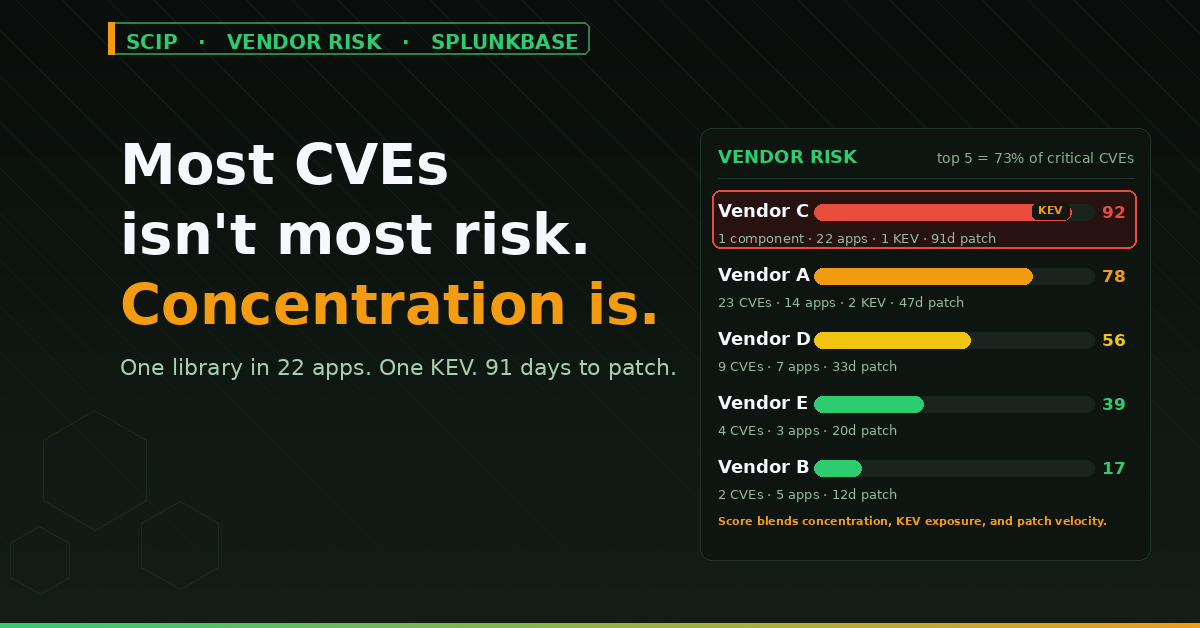
When one vendor's components carry the highest risk score across your portfolio, that's not a vulnerability problem, it's a vendor concentration problem.
The Vendor Risk Blind Spot
Third-party risk management is a mature discipline for SaaS and service providers. Your procurement team sends security questionnaires. Your compliance team reviews SOC 2 reports. Your legal team negotiates liability terms.
The software components your applications depend on, the libraries, frameworks, and tools that ship inside your products and run in your infrastructure, receive none of this scrutiny.
A single upstream vendor might supply components used across many of your applications. If that vendor has poor security practices or abandons a critical library, your entire portfolio inherits that risk. Most organizations have no visibility into this concentration.
What Vendor Risk Aggregation Shows
SCIP's Vendor Risk dashboard aggregates software supply chain risk by vendor and supplier across your entire SBOM portfolio.
Instead of viewing vulnerabilities one CVE at a time, you see them grouped by the entity responsible for the component, with a risk score, risk grade, and CVE breakdown for each:
Vendor A: 12 components with CVEs. 23 total CVEs. 4 critical, 6 high. 2 KEV matches. Risk score 87, Critical.
Vendor B: 3 components with CVEs. 2 total CVEs. 0 critical, 1 high. 0 KEV matches. Risk score 14, Minimal.
Vendor C: 1 component with CVEs. 6 total CVEs. 1 critical, 2 high. 1 KEV match. Risk score 71, High.
Vendor A has the most CVEs, but Vendor C might be your bigger concern relative to its footprint, a single component carrying a KEV match, pulling real weight in the risk score off one entry point. Ranked by risk score instead of raw CVE count, the vendor worth escalating first isn't always the one with the biggest number attached.
Concentration Risk Is the Real Threat
SolarWinds SUNBURST didn't exploit a CVE. It compromised a vendor's build pipeline, and every customer running that vendor's software was affected simultaneously.
XZ Utils didn't start as a vulnerability. It started as a single maintainer being socially engineered over two years, with malicious code inserted into a component embedded in nearly every Linux distribution.
Both attacks exploited vendor concentration: a single point of failure in the software supply chain that affected thousands of downstream consumers.
SCIP's Vendor Risk dashboard surfaces this concentration by ranking vendors on a single risk score built from CVE severity and KEV status. When a vendor with a KEV match sits at the top of that ranking, that's the one to look at first, regardless of how many total CVEs it's carrying.
Board-Ready Reporting
Your CISO needs to communicate supply chain risk to the board. "We have 500 open CVEs" is a number. It doesn't drive action.
"Our top vendor by risk score is Vendor C, risk score 71, driven by a KEV-matched critical vulnerability in a single component. Our recommendation is to escalate with Vendor C and begin evaluating alternatives for their component." That drives action.
SCIP's Vendor Risk dashboard produces per-vendor risk scores that roll up into executive-level reporting: risk score, risk grade, CVE distribution by severity, and KEV exposure, all ranked by vendor.
Integrating with Your Existing Third-Party Risk Program
If your organization already runs a third-party risk management program for service providers, vendor risk data from SCIP extends that program to software supply chain vendors.
Your procurement team evaluates a new software vendor. Your TPRM questionnaire covers their SOC 2, their incident response plan, their data handling practices. Now add: "What open-source components does your product embed, and what's their CVE and KEV exposure?" SCIP gives you the data to answer that question for vendors already in your portfolio, and to set baseline expectations for new ones.
SCIP adds vendor-level aggregation and risk-score ranking on top of component-level risk. Install SCIP from Splunkbase: splunkbase.splunk.com/app/8814
Which third-party vendor do you think contributes the most risk to your environment? Do you have data to prove it, or is it a guess?