The xz-utils backdoor (CVE-2024-3094) was not a vulnerability in the ordinary sense. The code wasn't buggy. It was sabotaged, a maintainer-level compromise that planted a backdoor into a compression library sitting deep in the Linux dependency graph.
It was caught by luck, by one engineer chasing a half-second of latency.
When the next one isn't caught early, the question won't be "is this CVE severe?" It will be "did this specific compromised version ever enter our software?"
A Different Class of Problem
A normal CVE is a flaw discovered in a component you already trust. The component is fine; a weakness was found in it. You assess severity, you check versions, you patch.
A supply-chain compromise inverts that. The component itself is the attack. A malicious version was published, through a hijacked maintainer account, a poisoned build, a typosquatted or confused package name, and the only thing that matters is a precise question: which of our builds ingested that exact version, in that exact window?
Severity scoring doesn't help you here. CVSS doesn't help you here. What helps is knowing your components down to the version, across everything you ship.
Why This Is Hard Without Component-Level History
Most teams can tell you their direct dependencies. Far fewer can tell you their transitive ones, the libraries their libraries pull in, three and four levels deep, which is exactly where xz-utils lived.
When a compromised version is announced as a narrow range, "malicious in 5.6.0 and 5.6.1, safe in 5.6.2", "we use xz-utils" is not an answer. "Application B shipped 5.6.0 between these dates" is an answer.
That precision is in your SBOMs. The problem is that SBOMs generated per application, sitting in a build system, are not a thing you can query under pressure.
Scoping a Compromise in One Search
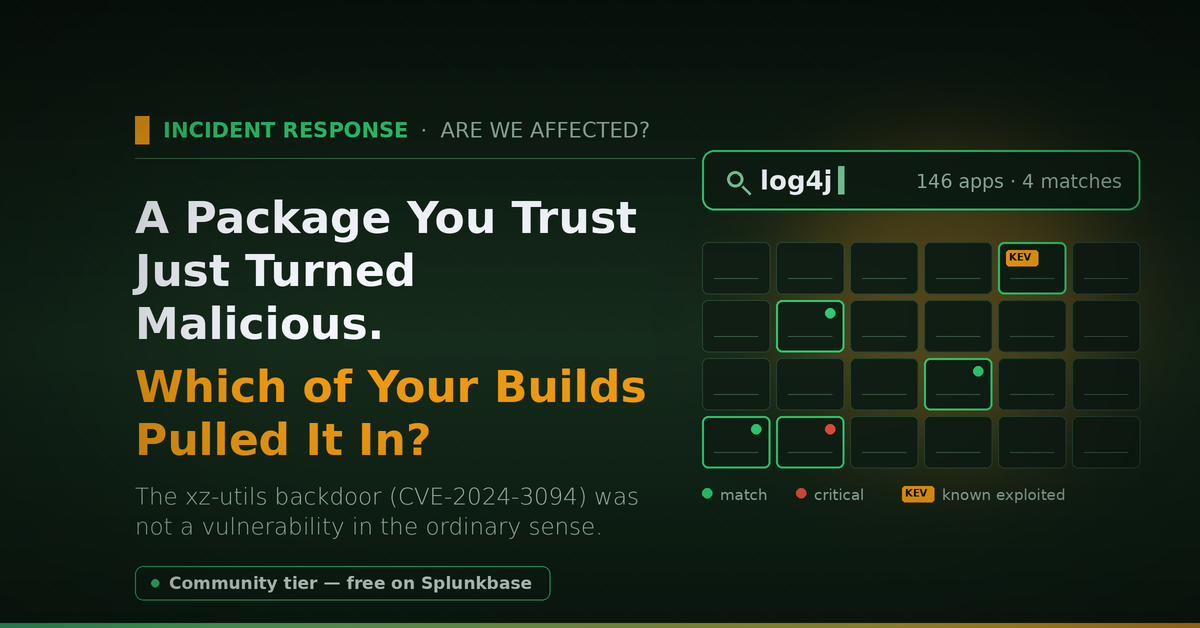
SCIP, the Supply Chain and AI Threat Intelligence Platform, keeps a continuously searchable component inventory built from every SBOM you generate into Splunk.
When a malicious package is disclosed, you search the component and the affected version range across your entire portfolio at once. SCIP returns every application that pulled it in, the exact version in each, and whether the associated identifiers are on CISA's Known Exploited Vulnerabilities list. Transitive dependencies are in scope, because they're in the SBOM, you're not limited to what your developers remember declaring.
If the search returns nothing, that's a finding: you weren't exposed, and you can say so with evidence instead of hope. If it returns results, you know precisely where to act, in seconds.
SCIP doesn't tell you a package is malicious, that determination comes from the disclosure. What it tells you, instantly, is whether the disclosure is your problem.
Be Ready for the One That Isn't Caught Early
Component Search ships in SCIP. Install from Splunkbase, ingest your SBOMs, and find out whether you can scope a compromise across your portfolio in one query: splunkbase.splunk.com/app/8814
xz-utils was caught by a fluke. The next one might be announced cold, on a Tuesday, naming a version range. Will you know in seconds whether it's in your software?
When the last supply-chain compromise made the news, how did your team scope exposure, and how long did it take? I'm curious where the real bottleneck was.